
A single spin of the Crazy Time wheel can pay out thousands of times the original stake, yet the game's long-run return sits at a fixed, published number that never changes because of a lucky streak or a cold table. That gap between the drama of a single round and the mathematics behind thousands of rounds is exactly where most players get confused, and exactly where an informed reader gains an edge in understanding what they're actually playing.
Crazy Time built its reputation on spectacle: a giant studio wheel, four bonus games, a live host, and multipliers that can spike into five-digit territory. But behind the confetti and camera work sits a deterministic system governed by a certified random number generator and a fixed pay table. Anyone researching crazy time live rtp quickly discovers that the number isn't a marketing figure - it's a mathematically derived percentage tied to wheel segment distribution and bonus round frequency. Understanding that distinction separates players who chase short-term variance from those who grasp the actual odds they're facing.
This guide breaks down how the game works, why its RTP percentage differs slightly depending on which bet you place, how the live streaming production affects (and doesn't affect) fairness, and what the payout structure actually rewards. By the end, you'll have a clear, technical picture of the numbers behind the show.
What Is Crazy Time and How the Live Game Works
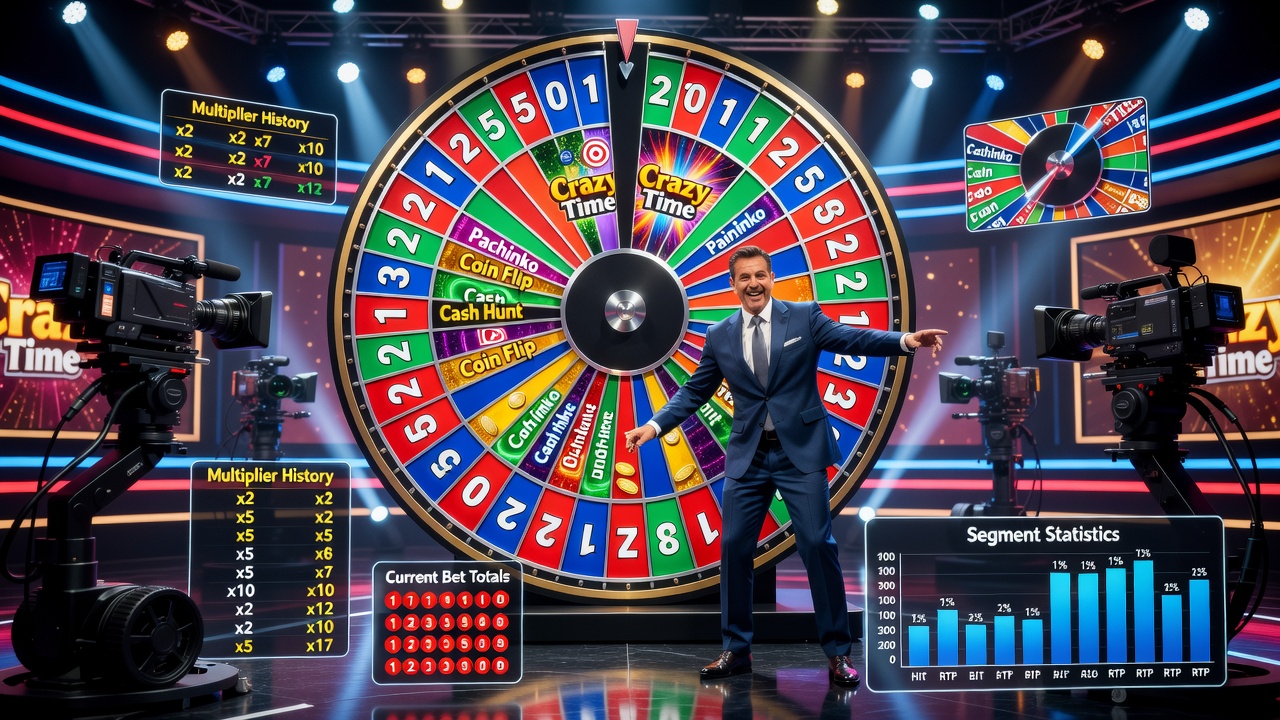
Crazy Time is a live dealer game show built around a large, physical wheel divided into 54 segments. Unlike a traditional table game, it merges casino wheel mechanics with a broadcast-style format, filmed in a dedicated studio and streamed to players in real time. The core wheel contains number segments (1, 2, 5, and 10) plus four bonus segments: Coin Flip, Pachinko, Cash Hunt, and Crazy Time itself. Each bonus segment triggers a separate mini-game with its own multiplier mechanics, distinct from the base wheel spin.
Core Wheel Mechanics and Segment Distribution
The 54 segments aren't evenly split. Number segments dominate the wheel by design, while bonus segments appear far less frequently. This imbalance is intentional: it keeps base bets frequent and predictable while making bonus rounds - the ones with the highest potential multipliers - statistically rarer events. The lower the segment frequency, the higher the potential payout tied to it, which is standard practice across most wheel-based formats.
The Role of the Live Host and Studio Presenter
A live presenter spins the wheel and narrates each round, but the outcome is governed entirely by the wheel's physical mechanism combined with a certified randomization system, not by the host. The presenter's role is theatrical and communicative - building anticipation for bonus rounds, explaining multiplier mechanics to new viewers, and keeping pacing consistent across rounds.
Bonus Rounds: Coin Flip, Pachinko, Cash Hunt, and Crazy Time
- Coin Flip: a two-sided multiplier reveal with the simplest mechanic of the four bonus games
- Pachinko: a vertical drop-board mechanic where a puck can land on a hidden multiplier or a "double" segment that increases all remaining values
- Cash Hunt: players select one of many icons hidden on a grid, each concealing a different multiplier
- Crazy Time: the flagship bonus, featuring a secondary wheel with a flapper mechanism that determines the final multiplier applied to that segment's bets
Understanding Crazy Time Live RTPUnderstanding Crazy Time Live RTP
The term RTP - return to player - describes the theoretical percentage of all wagered money that a game returns to players over a very large number of rounds. It is not a per-session guarantee. A player can lose ten rounds in a row or hit a 20,000x Crazy Time multiplier on their very first spin; neither outcome changes the long-run mathematical constant behind the game.
How RTP Percentage Is Calculated for Each Bet Type
Crazy Time doesn't have one single RTP - it has several, because each bet type (Number 1, Number 2, Number 5, Number 10, and each of the four bonus games) carries its own probability and payout structure. The Crazy Time RTP percentage for straightforward number bets tends to sit higher than the RTP tied to bonus segments, simply because number bets pay out more often even though the multipliers are smaller. Bonus-segment bets carry more variance: rarer wins, but with the potential for dramatically larger multipliers.
Why RTP Differs Between Bet Types (Numbers vs Bonus Games)
This differential exists by design. Game studios calibrate segment count, payout multiplier, and bonus mechanic odds together so that each individual bet type lands within an acceptable RTP range, typically somewhere in the mid-90s percent for most segments, with slight variation for the highest-volatility bonus. Players betting exclusively on Number 1, for instance, will experience a different risk-reward profile than those stacking chips on Crazy Time bonus bets, even though both bets belong to the same live game.
Theoretical RTP vs Real-World Session Results
Theoretical RTP describes an outcome that only converges over an enormous sample size - realistically, tens of thousands of rounds or more. In a single session of fifty or a hundred spins, actual returns can swing wildly above or below the published percentage. This is the nature of variance, and it's why judging a game's fairness from one evening of play is statistically meaningless.
Crazy Time Live Streaming: Production, Fairness, and Technology
The live streaming layer is what separates Crazy Time from a standard digital slot or RNG-only table game. Multiple camera angles, real-time graphics overlays showing multiplier history, and a dedicated studio set create the show-like experience players recognize. But production value and game fairness are two separate systems working in parallel.
How the Wheel's Outcome Is Verified as Fair
The physical wheel's stopping position is captured by an optical camera recognition system, cross-checked against a certified random number generator that determines bonus round outcomes and multiplier values within the mini-games. This dual-verification approach means the flashy visuals never influence the mathematical result - the outcome is locked in independently of how it's presented on screen.
Streaming Quality, Latency, and Player Experience
Because Crazy Time is broadcast continuously to a global audience, stream stability directly affects usability. Low latency matters more here than in slower table games, since betting windows close before each spin and players need real-time confirmation of results. Buffering or delayed streams can create a disconnect between what a player sees and what has already been wagered elsewhere on the shared game round - a structural reality of any live, shared-outcome format.
Multi-Camera Angles and Real-Time Data Overlays
Modern Crazy Time broadcasts use several synchronized camera feeds - a wide shot of the studio, a close-up on the wheel, and dedicated angles for each bonus game. Real-time overlays display top multiplier history, current bet totals, and segment statistics, giving players context without needing to track results manually across sessions.
Crazy Time Payout RTP: How Winnings Are Actually Calculated
Payout structure and RTP are related but distinct concepts. RTP describes the long-run percentage return; payout describes what a specific winning bet actually delivers in that single round, which depends entirely on which segment or bonus multiplier was hit.
Base Game Payouts (Numbers 1, 2, 5, 10)
Number bets pay out at a fixed ratio tied directly to the number itself - a Number 10 win pays higher than a Number 1 win, but Number 1 segments appear far more frequently on the wheel. This inverse relationship between frequency and payout size is the backbone of the entire game's balance.
Bonus Game Multiplier Payouts and Top Win Potential
Bonus rounds carry the game's headline-grabbing multipliers. Crazy Time's top-tier bonus wheel can theoretically produce results in the tens of thousands multiplied against the original stake, though such outcomes are extremely rare by design - that scarcity is precisely what keeps the overall Crazy Time payout RTP balanced across all bet types.
How the "Double" and "Triple" Multiplier Mechanics Affect Payouts
Certain bonus rounds, particularly Pachinko, include multiplier-doubling segments that can escalate every value on the board before the final result lands. These mechanics increase variance without altering the underlying theoretical RTP - they redistribute win size rather than change the overall percentage returned across all players over time.
Comparing Crazy Time RTP Percentage Across Bet Types
Because Crazy Time offers multiple simultaneous betting options within one live round, comparing RTP percentage across bet types gives a clearer picture of risk versus reward than looking at a single blended average.
Number Bets vs Bonus Bets: Risk and Reward Trade-Off
Number bets generally offer a smoother, more frequent return pattern with lower peak payouts. Bonus bets offer the opposite: long stretches without a hit, punctuated by the potential for outsized multipliers. Neither approach is objectively better - the choice depends on a player's tolerance for variance and session length.
Which Bet Type Offers the Most Consistent Returns
Number 1, being the most frequent segment on the wheel, tends to produce the steadiest, most predictable stream of small wins across a session, making it the closest thing Crazy Time offers to a low-variance strategy within an inherently high-variance game.
Long-Term Volatility Patterns Across the Wheel
Across thousands of rounds, the wheel's built-in segment ratios ensure that bonus rounds trigger roughly in line with their designed probability, even though any short sequence can deviate sharply. This is standard behavior for any properly certified randomization system and isn't unique to Crazy Time specifically.
Tips for Reading and Using RTP Data Before You Play
Understanding published RTP figures is only useful if a player knows how to apply that knowledge practically, rather than treating it as a prediction tool for individual rounds.
How to Interpret Published RTP Figures Correctly
Treat RTP as a description of aggregate behavior over an enormous number of rounds, not a forecast for your next session. A 95% RTP does not mean you'll get back 95 cents of every dollar tonight - it means that across an enormous population of bets, that's the average return.
Setting Realistic Expectations for Session Variance
Short sessions naturally produce results far removed from theoretical RTP in either direction. Recognizing this prevents two common mistakes: assuming a losing streak means the game is "due" for a win, and assuming a hot streak reflects a permanently better return rate.
Bankroll Management Strategies for High-Volatility Live Games
- Set a fixed loss limit before starting a session and stop once it's reached
- Split bets across number segments and bonus segments rather than concentrating everything on one high-volatility option
- Track session length rather than individual round outcomes to judge whether behavior matches expected variance
- Avoid increasing bet size specifically to "chase" a bonus round that feels overdue
Frequently Asked Questions
Is Crazy Time's RTP the same for every bet I place?
No. Each bet type - Number 1, 2, 5, 10, and each of the four bonus games - carries its own distinct RTP percentage based on segment frequency and payout size. Number bets typically land at a different RTP range than bonus bets, since the two carry different variance profiles.
Does the live host or presenter influence the outcome of each spin?
No. The presenter's role is purely presentational - spinning the wheel and narrating the action. The actual outcome is determined by the physical wheel mechanism combined with a certified randomization system for bonus round multipliers, entirely independent of the host.
Can I predict when a bonus round is "due" based on past spins?
No. Each spin is an independent event, and past results have no bearing on future outcomes. The segment distribution only holds true as an average across a very large number of rounds, not as a pattern that evens out predictably in the short term.
Why do bonus rounds pay so much more than number bets?
Bonus segments appear far less frequently on the wheel than number segments, so their potential multiplier is scaled up to compensate for that rarity. This inverse relationship between frequency and payout is what keeps the overall RTP balanced across every bet type.
Does stream quality or latency affect my actual winnings?
No, stream quality affects viewing experience and timing, not the mathematical outcome of the round. However, poor latency can make it harder to place bets before the window closes or to follow bonus round mechanics clearly in real time.
Is a higher RTP percentage always the better choice for a bet type?
Not necessarily. A higher RTP with lower variance means smaller, more frequent wins, while a lower RTP tied to high-multiplier bonus bets can occasionally produce far larger single payouts. The right choice depends on whether a player prioritizes steady returns or occasional large-scale wins.