
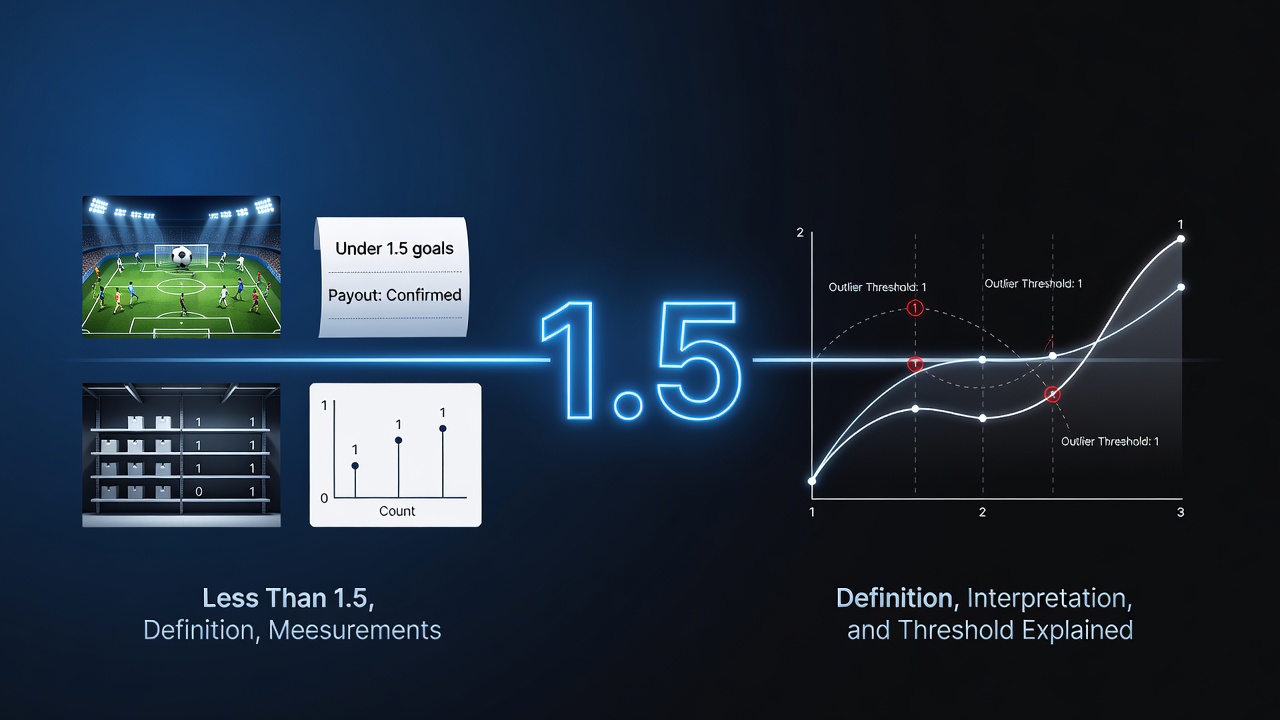
A number sitting below 1.5 rarely announces itself as important, yet in statistics, betting markets, scientific measurement, and financial ratios, that specific boundary separates one category of outcome from another entirely. The figure 1.5 shows up so often as a dividing line precisely because it splits whole numbers cleanly - anything from 0 up to 1 falls under it, while 2 and above sits over it. Understanding what a result below this line actually communicates requires more context than most people assume.
The phrase itself sounds simple, but its application shifts depending on the field. In sports wagering, for instance, a market asking whether total goals will land less than 1.5 is really asking whether the match will produce zero or one goal combined - nothing more. Readers researching this exact scenario often land on resources like the one explaining under 1.5 meaning, which breaks down how sportsbooks structure these lines. That same logic, once understood, transfers cleanly into other domains where thresholds define categories rather than exact quantities.
This article walks through every major context where the boundary matters, clarifies how to read a result that falls short of it, and explains why the number 1.5 specifically - rather than 1 or 2 - became the standard cutoff in so many systems. By the end, the ambiguity around under 1.5 definition and its many applications should disappear.
What "Less Than 1.5" Actually Means
The less than 1.5 meaning is arithmetically straightforward: any value smaller than one and a half units. In continuous measurement - length, weight, temperature, time - this includes every decimal between 0 and 1.499999, an infinite range of possibilities. In discrete counting, where only whole numbers exist, "less than 1.5" collapses to exactly two outcomes: 0 or 1. That distinction between continuous and discrete contexts explains most of the confusion people encounter when they first meet this threshold.
Continuous vs. Discrete Values Under 1.5
A thermometer reading, a stock price, or a chemical concentration can land anywhere below 1.5, including fractional values like 0.87 or 1.32. Counting scenarios behave differently. You cannot score 0.6 of a goal or record 1.3 customer complaints - the units must be whole. This is why betting lines, quality-control thresholds, and inventory counts almost always use half-values like 1.5 as boundaries: they eliminate the possibility of a tie or an ambiguous result.
Why 1.5 Is Used as a Dividing Line
Whole numbers create ties. If a threshold were set at exactly 1, someone landing precisely on 1 would need an additional rule to determine which side they fall on. Setting the line at 1.5 removes that problem entirely for integer-based counts, since no whole number can equal 1.5. This mathematical convenience is the real reason the figure appears so frequently across unrelated fields.
Under 1.5 Definition in Different Contexts
The under 1.5 definition changes meaning substantially depending on what is being measured. A sports statistic, a lab result, and a financial ratio all use the same numeric boundary but represent entirely different real-world conditions.
Statistical and Data Analysis Context
In data sets, values under 1.5 often signal low frequency, low magnitude, or a result near the bottom of an expected range. Analysts frequently use 1.5 as a multiplier in outlier detection - the well-known interquartile range method flags data points more than 1.5 times the IQR beyond the quartiles as anomalies. Here, "under 1.5" isn't about the raw value itself but about a calculated distance from a statistical center point.
Sports and Betting Terminology
This is where the threshold under 1.5 appears most visibly to everyday readers. A "total under 1.5" market in football betting pays out when the combined goals in a match equal 0 or 1. Because half-goals cannot occur, this line guarantees a clean win-or-lose result with no possibility of a push or refund. The same structure applies to cards, corners, or any countable in-game statistic.
Scientific and Measurement Context
In laboratory settings, a reading under 1.5 - whether it's a pH deviation, a concentration level, or a ratio like body mass index components - typically indicates a measurement within a lower-bound category. Scientific thresholds tend to be tied to specific units and calibrated instruments, so context always matters more than the bare number.
- Data analysis: outlier detection multiplier
- Betting markets: total count boundary (0 or 1 events)
- Scientific measurement: lower-range classification
- Financial ratios: below-target performance indicator
Interpretation of a Value Under 1.5
Numbers rarely speak for themselves. The interpretation of a value under 1.5 depends heavily on what "normal" or "expected" looks like in that particular system.
What a Low Result Typically Signals
In most counting-based systems, a result under 1.5 signals scarcity or restraint - fewer events, lower output, reduced activity. In a football match, an under-1.5 result means the game was low-scoring, often reflecting strong defensive play or weaker attacking performance from both sides. In inventory or production metrics, a figure under this line might indicate a shortfall against a target.
Context That Changes the Interpretation
The same number can mean success or failure depending on the goal. A financial ratio under 1.5 might be worrying in one industry (suggesting insufficient liquidity) and perfectly acceptable in another where lower ratios are standard. Reading a bare number without its surrounding benchmark leads to faulty conclusions almost every time.
Common Misreadings to Avoid
People sometimes assume "under 1.5" includes the value 1.5 itself - it does not. Strict inequality means 1.5 is excluded; only numbers genuinely smaller count. Another frequent error is treating continuous and discrete thresholds identically, forgetting that discrete systems collapse the range into just one or two whole-number outcomes.
Threshold Under 1.5: How It's Set and Applied
Thresholds don't appear randomly. Someone - an analyst, a regulator, a bookmaker, a scientist - chooses 1.5 deliberately based on the behavior of the system being measured.
How Analysts Determine This Boundary
In statistics, the threshold under 1.5 in outlier detection comes from decades of practical testing; it balances sensitivity against false positives reasonably well across many distributions. In betting markets, oddsmakers set the 1.5 line based on historical scoring averages for the specific teams or leagues involved, adjusting the associated odds rather than the line itself when one outcome becomes more likely.
Industry-Specific Threshold Standards
Manufacturing quality control might set defect rates under 1.5 per thousand units as an acceptable tolerance. Financial auditing might flag ratios under 1.5 as requiring further review. Each industry calibrates the boundary to its own historical data and risk tolerance, which is why the same numeric line carries different weight depending on where it's applied.
What Does Under 1.5 Indicate - Practical Examples
Abstract definitions become clearer with concrete scenarios. Here's what does under 1.5 indicate across a few everyday situations.
Real-World Example in Finance
A current ratio under 1.5 suggests a company holds less than one and a half dollars in short-term assets for every dollar of short-term liability. That's not automatically a crisis, but it does warrant closer inspection of cash flow timing and upcoming obligations.
Real-World Example in Sports Statistics
A team averaging under 1.5 goals per game across a season is, by definition, a low-scoring side. Bettors and analysts use this figure to project future match outcomes, adjust betting lines, and evaluate attacking form relative to league averages.
Real-World Example in Everyday Measurement
A recipe calling for under 1.5 cups of liquid means anything up to but not including 1.5 cups - 1.25 cups qualifies, 1.5 itself does not, strictly speaking, though most cooks treat it as close enough in practice.
Frequently Asked Questions
Does "under 1.5" include the number 1.5 itself?
No. Strict inequality excludes the boundary value. Only numbers smaller than 1.5 count, so 1.499 qualifies but 1.5 does not.
Why do betting markets use 1.5 instead of a whole number?
Half-values prevent ties. Since goals, cards, or corners are always whole numbers, a line of 1.5 guarantees a clear winning or losing outcome with no possibility of a push.
Is a value under 1.5 always considered low or bad?
Not necessarily. Whether it's favorable depends entirely on the system's benchmark. A low defect rate under 1.5 is good; a low liquidity ratio under 1.5 might raise concern.
How is the 1.5 threshold chosen in statistical outlier detection?
It comes from the interquartile range method, where 1.5 times the IQR beyond the upper or lower quartile marks the boundary for flagging unusual data points. This multiplier was adopted because it performs reliably across a wide range of real-world distributions.
Can "under 1.5" apply to negative numbers?
Yes. Any number smaller than 1.5, including zero and negative values, satisfies the condition. The threshold has no lower limit unless one is explicitly stated elsewhere.
What's the difference between "under 1.5" and "1.5 or less"?
"Under 1.5" strictly excludes 1.5, while "1.5 or less" includes it. This small wording difference changes which values count, especially in scoring, grading, or eligibility criteria.