
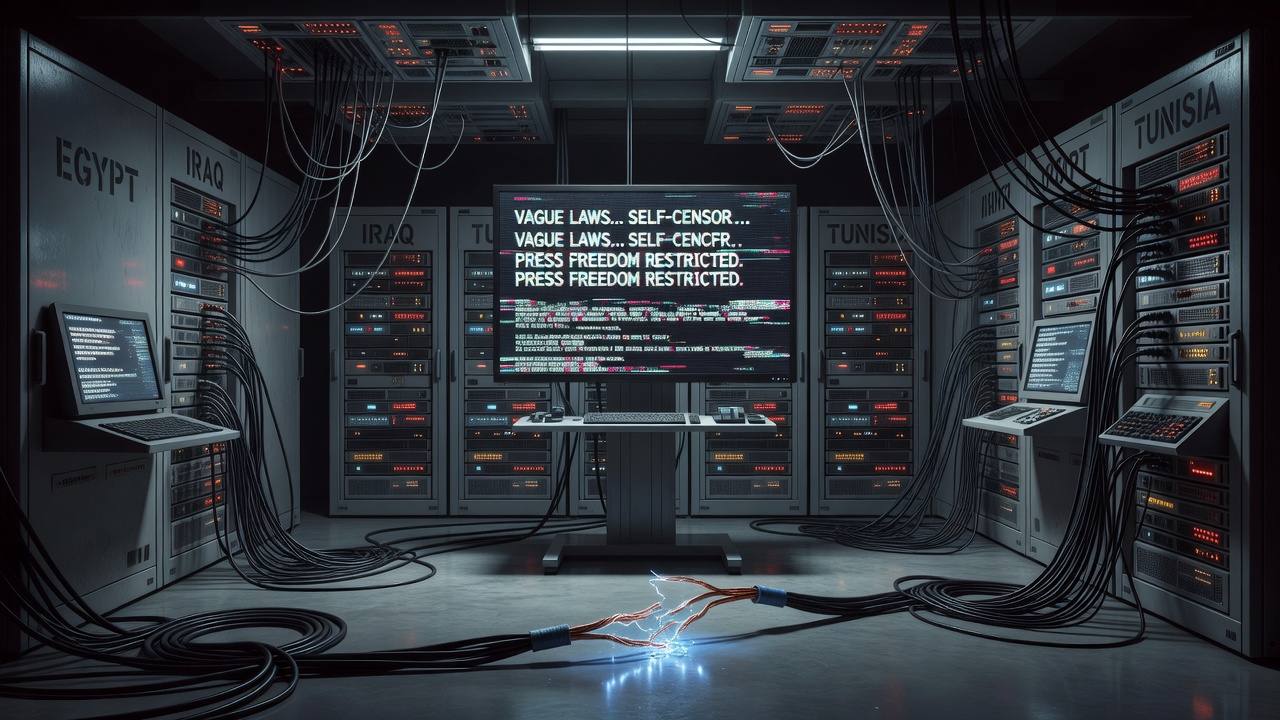
The most effective tool for silencing a journalist or human rights lawyer in the Middle East and North Africa is often not a prison cell but a sentence left deliberately unclear in the penal code. A year of conversations with journalists, lawyers, and digital rights activists in Egypt, Iraq, and Tunisia points to a consistent pattern: legislation governing speech, cybercrime, and online activity is written loosely enough that people censor themselves long before any state agency has to intervene. The chilling effect becomes the enforcement mechanism.
That vagueness is not incidental. Cybercrime and "fake news" statutes across the three countries tend to use broad, undefined terms, phrases like endangering national security, spreading false information, or disturbing public order, that can be stretched to cover almost any critical reporting or legal advocacy. When professionals cannot predict what will trigger prosecution, many simply stop publishing certain stories, delete old social media posts, or route sensitive work through encrypted channels and, increasingly, through privacy tools whose costs and features vary widely; resources like VPN pricing compared have become part of the quiet infrastructure many now rely on just to work safely online. The result is a profession practicing law and journalism under constant, low-grade anticipatory fear rather than open confrontation with the state. VPN pricing compared
When Legal Pressure Becomes Physical Danger
Self-censorship is only the first layer of risk. Researchers found that online harassment campaigns and doxxing, the public release of personal information intended to intimidate, regularly escalate into offline harm. Activists described office raids following coordinated social media attacks, and in some cases physical assaults that traced back to information first circulated online. The digital and physical worlds have effectively merged as threat environments: a hostile tweet thread or a leaked address can precede a very real knock at the door. This dynamic makes conventional digital security advice, strong passwords, careful metadata handling, feel insufficient on its own when the ultimate consequence plays out in physical space.
Disinformation Without Guardrails
Compounding the legal and physical risks is the rapid spread of AI-generated disinformation across a region with no established regulatory framework for addressing it. Synthetic images, fabricated audio, and manipulated video can now be produced and distributed faster than independent journalists or fact-checking networks can respond, let alone correct the record. Without clear legal definitions of synthetic media or platform accountability rules, false narratives often outlast their debunking, shaping public opinion and, in some documented cases, providing pretext for further crackdowns on the very journalists trying to counter them.
Shrinking Support, Growing Exposure
All of this is unfolding as the financial support structure for independent media and digital rights work weakens. The 2025 cuts to US foreign aid have reduced funding that previously underwrote legal defense, digital security training, and emergency relocation support for at-risk journalists and activists in the region. Organizations are now expected to do more protective work with considerably fewer resources, at precisely the moment when legal, physical, and informational threats are compounding rather than easing. The combined effect, as the research from SMEX details in full, is a form of governance built less on overt censorship than on sustained uncertainty and fear.